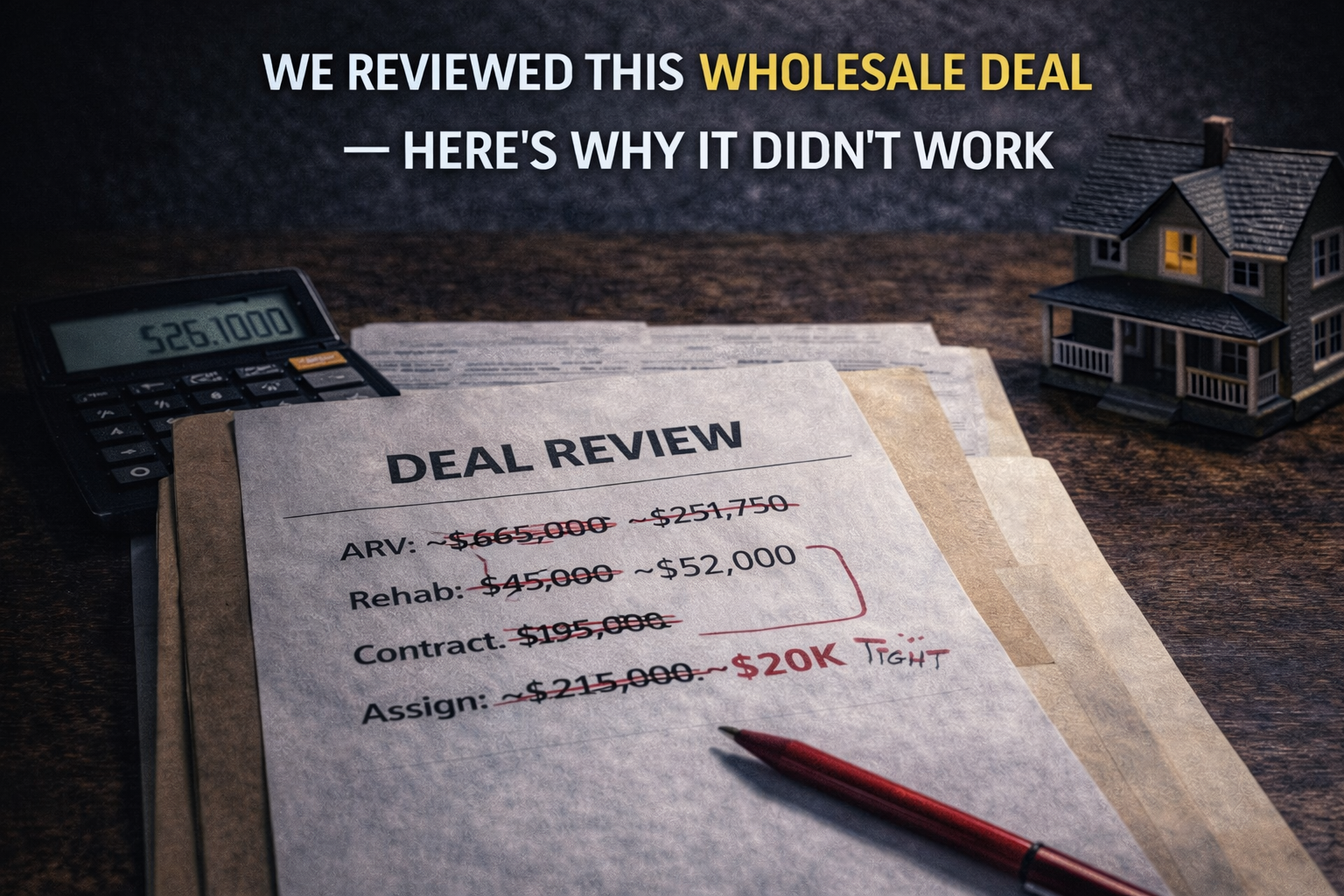


How to Know If Your Wholesale Deal Is Actually Good (Before You Blast It)
Every new wholesaler thinks they’ve locked up a great deal.
The seller agreed.
There’s “equity.”
The numbers look solid on paper.
Then you blast it to your buyer list…
And nobody bites.
Before you assume buyers are flaky, you need to understand something:
Investors don’t buy excitement.
They buy margin, risk control, and liquidity.
Here’s how to know if your wholesale deal is actually good — before you send it out.
1. Is Your ARV Conservative — and Supported by the Market Right Now?
Most wholesale deals die here.
New wholesalers comp properties based on:
• The highest sale in the neighborhood
• Renovated homes that are superior
• Price per square foot averages
• Or only one recent comp
Investors comp differently.
We look at recent sold comps first — because that’s what buyers actually paid.
But we also look at active listings and days on market.
Here’s why:
If a similar house sold for $250,000 in 10 days three months ago, that’s useful.
But if today a similar house is listed at $250,000 and has been sitting for 90 days — that tells you something changed.
Market momentum matters.
Active listings tell you:
• Whether pricing is softening
• Whether demand is slowing
• Whether inventory is stacking
• Whether ARV needs to be adjusted downward
ARV is not just about what sold.
It’s about what will sell when your buyer finishes the rehab.
A strong wholesale deal survives conservative comping and current market conditions.
2. Is Rehab Underestimated?
Rehab is rarely cheaper than you think.
New wholesalers:
• Forget holding costs
• Forget permit surprises
• Forget material spikes
• Forget labor overruns
Investors price for worst case, not best case.
If your rehab number feels tight, buyers will widen it.
And that eats your assignment fee fast.
3. Is There Enough Margin After Risk?
Here’s a simple truth:
A deal that “works on paper” doesn’t automatically work in reality.
Ask:
• If ARV comes in 10k lower, does it still work?
• If rehab goes 15% over, does it still work?
• If it sits 60 extra days, does it still work?
If one small shift kills the deal, buyers will pass.
Strong deals survive stress testing.
4. Is Your Assignment Fee Proportional to Risk?
There’s nothing wrong with making money.
But if the investor margin is thin and your assignment is heavy, it won’t move.
Investors ask:
“What’s my return relative to risk?”
If they’re risking $50k and netting $12k, that’s not attractive.
If they’re risking $50k and netting $35k, that’s different.
Understand what side of that line you’re on.
5. Are You Solving a Problem — or Creating One?
The best wholesale deals solve problems:
• Seller needs speed
• Property needs work
• Title needs clarity
• Terms need structure
Bad deals create problems:
• Tight equity
• Messy structure
• Thin margins
• Unrealistic expectations
If buyers have to “hope” it works, they won’t buy it.
Before You Blast It
Here’s something most new wholesalers miss:
Some of the best deals never get blasted.
They get sent directly to a serious buyer who understands structure, debt, and risk.
If you just locked up a deal and you’re not sure whether it’s strong — or you’re about to blast it and hope — take a different approach.
Have someone underwrite it first.
I primarily operate in Tennessee but review deals nationwide.
If the numbers make sense, I may take it down.
If they don’t, I’ll tell you why.
No hype. Just clarity.
Before you blast it — send it here: