

Why Most Wholesale Deals Aren’t Actually Deals
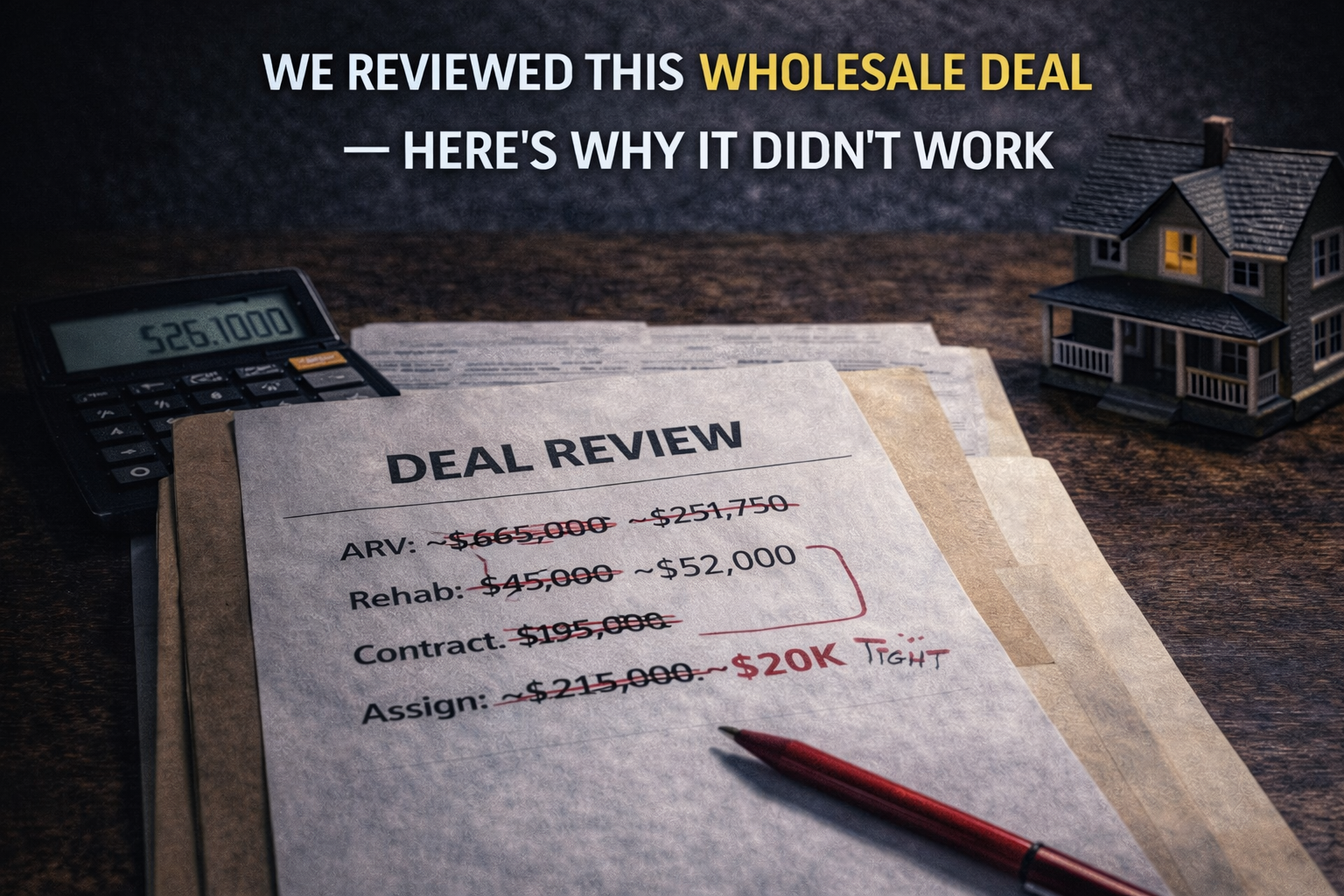
A “deal” is not a discounted property.
A deal is a property that still works after you stress-test it.
Most wholesalers don’t stress-test.
They comp it.
They subtract rehab.
They subtract their fee.
They send it out.
That’s not underwriting. That’s math without risk modeling.
Let’s break down what serious buyers actually look at.
1. ARV Isn’t a Number — It’s a Range
Wholesalers typically pick:
• The highest recent sale
• The best comp
• The one that helps the deal
Investors don’t underwrite the best-case scenario.
They underwrite the most probable exit.
Instead of saying:
“ARV is $250,000.”
A real investor asks:
-
What is the lowest comparable sale in similar condition?
-
What are actives listed at right now?
-
What are current days on market?
-
Are listings reducing price?
If the top sale is $250K but:
-
Two active listings are at $249K sitting 70 days
-
One just reduced to $239K
Your real ARV may be closer to $235K–$240K.
That difference alone can wipe out your assignment fee.
If you want to understand how buyers actually approach this, read:
How Investors Underwrite Wholesale Deals
That article breaks down the underwriting mindset from the capital side.
2. Rehab Is Almost Always Underestimated
Here’s a common pattern:
Wholesaler estimate: $40,000
Investor real cost: $55,000
Why?
Because wholesalers price cosmetic.
Buyers price structural risk.
Investors build in:
-
Permit delays
-
Contractor variability
-
Material price swings
-
Scope creep
-
Holding cost overruns
If rehab runs 15–20% higher, does the deal still work?
If not — it wasn’t strong.
3. Margin Isn’t Spread — It’s Cushion
Let’s look at an example.
Contract price: $180,000
Rehab: $50,000
ARV: $250,000
Looks like $20K–$30K margin after costs, right?
Now stress-test:
What if ARV lands at $240K instead of $250K?
What if rehab is $60K?
What if it takes 90 days longer to sell?
Now your profit is single digits — or gone.
Serious investors want margin after:
-
8–10% selling costs
-
Financing costs
-
Carry costs
-
Unexpected overruns
If net profit doesn’t land 12–18%+ of total capital deployed, many buyers walk.
If you’re unsure whether your deal survives that pressure, read:
How to Know If Your Wholesale Deal Is Good
That piece shows how to pressure-test before you blast it.
4. Time Risk Is Real Risk
Most wholesalers ignore time.
But capital has a cost.
If a flip takes:
-
4 months → great
-
8 months → problem
-
12 months → disaster
Every extra month:
-
Increases interest
-
Increases utilities
-
Increases insurance
-
Increases market exposure
If DOM in your area is creeping up, buyers will compress their purchase price to account for time risk.
That’s often why your deal “should work” but no one bites.
If that’s happening, this breakdown may explain it:
Why Your Wholesale Deal Isn’t Selling
It’s rarely personal. It’s usually math.
5. The Exit Strategy Has to Be Clear
A real deal should answer one of these clearly:
-
Is this a flip with margin?
-
Is this a rental with yield?
-
Is this a BRRRR with refinance upside?
If it doesn’t clearly fit one box, it’s speculative.
Speculation isn’t investing.
It’s gambling with a spreadsheet.
6. Why Thin Deals Are Dangerous Long-Term
Here’s the real risk for wholesalers:
If you consistently send thin deals:
-
Buyers stop opening your emails
-
Your reputation softens
-
Your list engagement drops
-
Your negotiating leverage weakens
Long-term wholesalers survive because buyers trust the math.
They know:
“If it came from him, the numbers are real.”
That’s an asset.
Final Thought
Strong deals survive friction.
Weak deals collapse under it.
If a deal only works when everything goes perfectly, it’s not a deal.
It’s optimism.
And optimism doesn’t close transactions.
Numbers do.
Explore More Wholesale Deal Breakdowns
For more in-depth analysis on stalled and borderline wholesale transactions, visit:
https://rogersip.com/category/wholesale-deal-rescue/