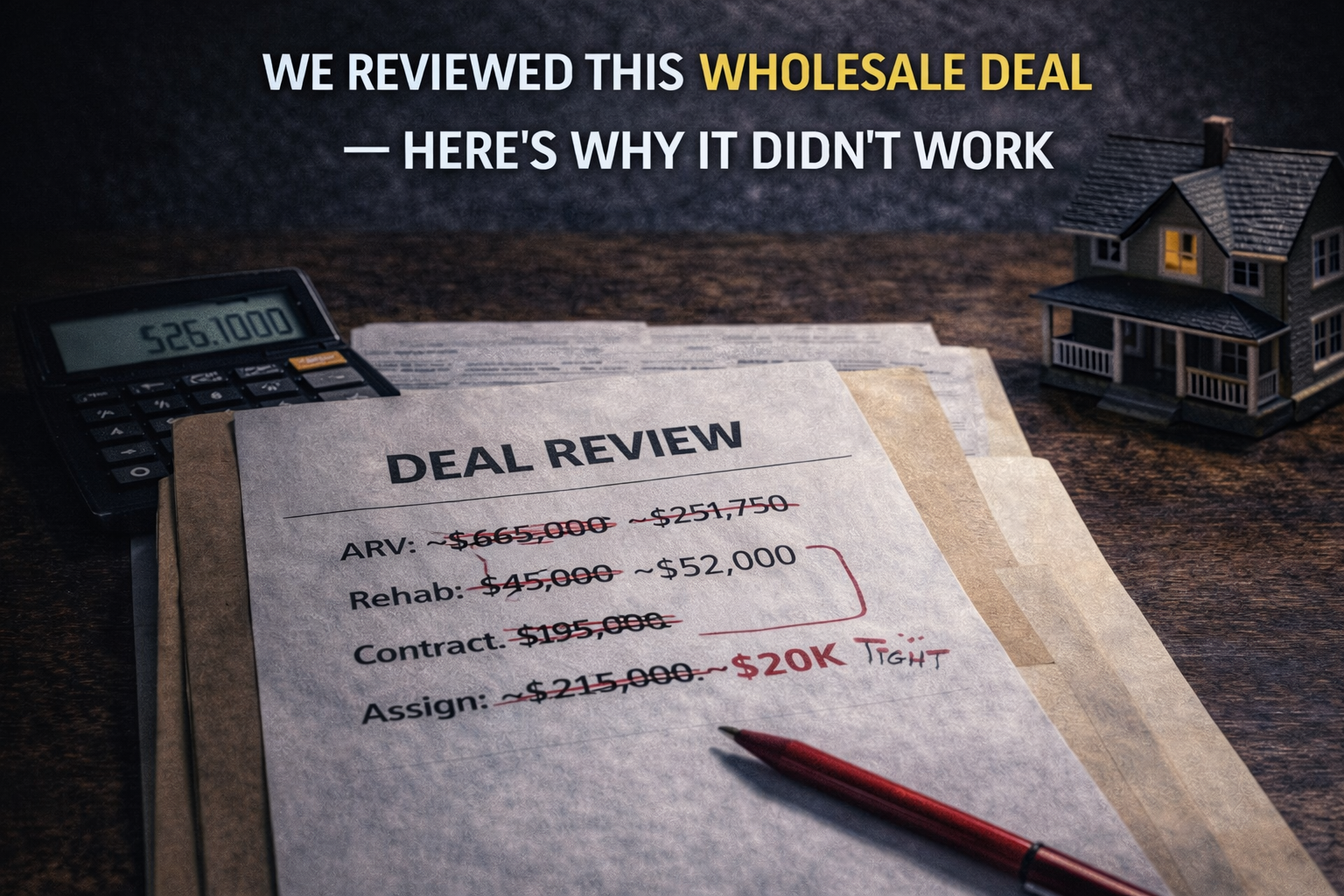


The Wholesale Deal Stress Test: A Checklist Before You Send It
Most wholesalers send deals too early.
They comp it.
They estimate rehab.
They calculate spread.
They blast it out.
Then they wait.
And wait.
And wonder why buyers hesitate.
The difference between amateur and professional wholesalers isn’t marketing.
It’s stress testing.
Before a deal ever hits your buyer list, it should survive pressure.
Here’s the checklist serious operators run.
1️⃣ ARV Compression Test
Take your ARV.
Reduce it by 5%.
Does the deal still work?
Now reduce it by 10%.
Still work?
If your deal dies under mild compression, you’re pricing off peak optimism.
If you haven’t read this yet, it explains the ARV illusion clearly:
ARV vs Reality: Why Comps Alone Don’t Make a Deal Work
Strong deals survive compression.
Weak deals rely on perfect comps.
2️⃣ Rehab Overrun Buffer
Increase your rehab estimate by 15%.
Does margin survive?
Contractors miss things.
Scope creeps.
Permits delay.
If your spread evaporates with a modest overrun, the deal is thin.
This is directly connected to:
The 5 Pricing Mistakes New Wholesalers Make
Underestimating rehab to protect your fee is a short-term strategy.
3️⃣ Timeline Risk Test
Extend holding time by 60 days.
Add:
-
Two more mortgage payments
-
Utilities
-
Insurance
-
Interest
Still profitable?
Markets shift quietly. DOM creeps slowly. Buyers slow down without warning.
If you haven’t adjusted for slower velocity, read:
How to Price a Wholesale Deal in a Slowing Market
Time risk is real risk.
4️⃣ Buyer Margin Reality Check
After compression, rehab buffer, and timeline extension…
What’s the buyer’s net profit?
If it’s under 12–15% of capital deployed in today’s environment, expect pushback.
If you’re forcing a large assignment fee on top of thin margin, revisit:
How Much Assignment Fee Is Too Much?
Fees don’t kill strong deals.
They expose weak ones.
5️⃣ Exit Strategy Clarity
Ask:
Is this clearly a flip?
Is it clearly a rental?
Is it clearly a BRRRR?
If the answer is “maybe,” buyers hesitate.
Ambiguity reduces velocity.
Clarity increases it.
6️⃣ Market Direction Snapshot
Before sending:
-
Is inventory rising?
-
Are price reductions increasing?
-
Is DOM expanding?
-
Is absorption weakening?
If yes — compress more.
If you ignore direction, your deal may “look good” but fail in reality. That breakdown lives here:
When a Wholesale Deal Looks Good — But Isn’t
The 60-Second Summary
Before blasting a deal, ask:
-
Survives 5–10% ARV compression?
-
Survives 15% rehab overrun?
-
Survives 60-day delay?
-
Leaves buyer 15%+ margin?
-
Clear exit strategy?
-
Market direction accounted for?
If yes — send it.
If no — adjust it.
Why This Matters Long-Term
Buyers remember who sends tight deals.
They remember who sends real ones.
If your deals consistently survive stress testing, buyers trust you faster.
Trust compounds.
And when trust compounds, your dispo gets easier.
Not Sure If Your Deal Passes the Stress Test?
If you’re sitting on a contract and unsure whether it survives pressure, submit it here:
Wholesale Deal Review – RogersIP
We’ll run the stress test with you.
Straight numbers. No fluff.
More Wholesale Deal Breakdowns
Explore the full underwriting series here: