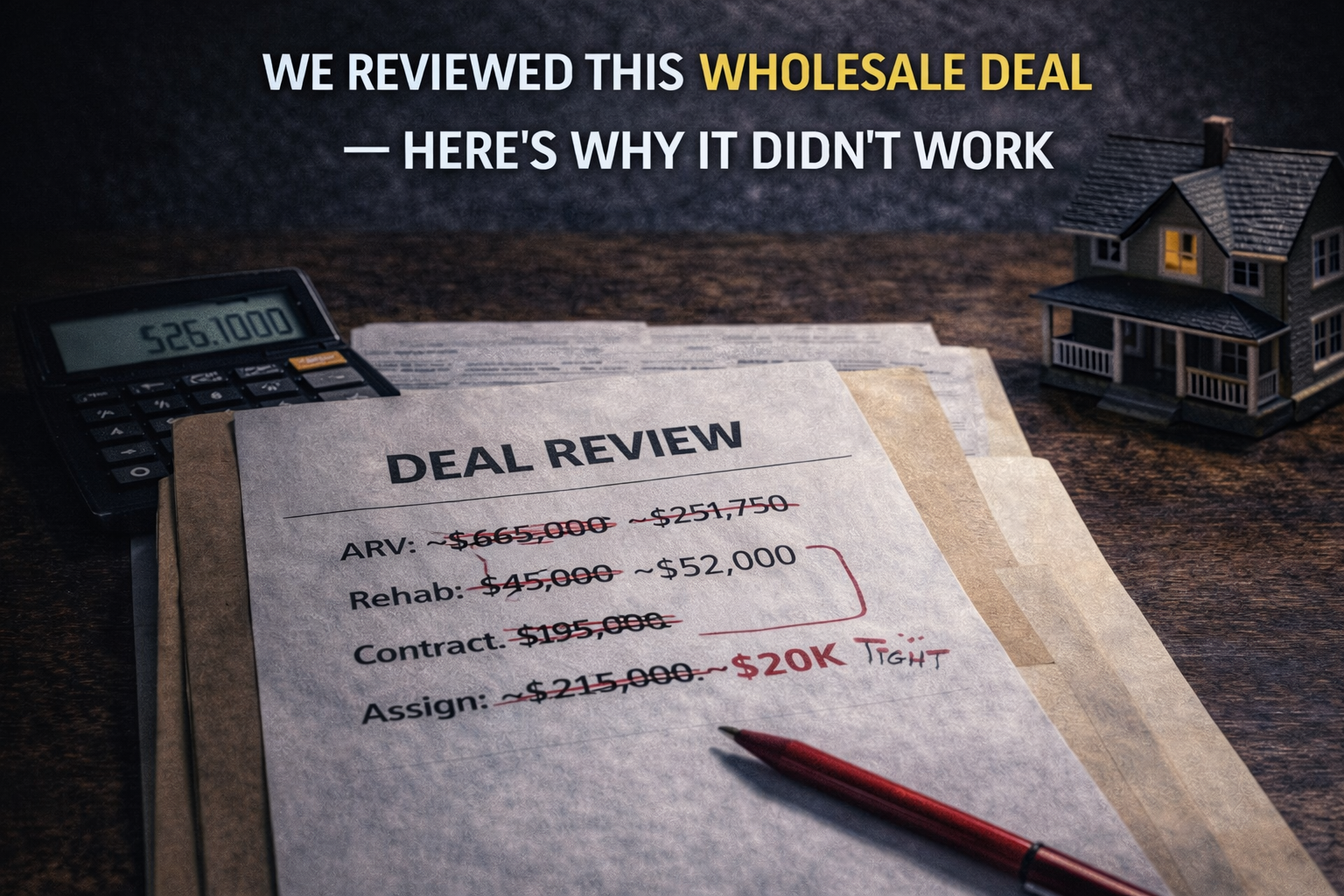


ARV vs Reality: Why Comps Alone Don’t Make a Deal Work
If you’ve been wholesaling for any amount of time, you’ve heard this:
“ARV is $250K. The comps prove it.”
But here’s the problem.
Comps show you where the market was.
They do not tell you where it’s going.
And they definitely don’t guarantee what your buyer will actually sell for.
If your entire deal depends on one number pulled from past sales, you’re not underwriting.
You’re anchoring.
The ARV Illusion
Most wholesalers build deals like this:
Highest comp
– Rehab
– Profit
– Fee
= Contract price
That works in a rising market.
It fails in a shifting one.
Because ARV isn’t a fixed number.
It’s a moving target.
And if you haven’t read this yet, this explains how investors actually think through it:
How Investors Underwrite Wholesale Deals
Buyers don’t underwrite the best comp.
They underwrite the most probable exit.
Sold Comps vs Active Listings
Sold comps are historical.
Active listings are competitive.
If you have:
-
One sale at $250K
-
Two active listings at $245K sitting 60+ days
-
One price reduction to $239K
Your ARV isn’t $250K.
It’s under pressure.
This is exactly why some deals “look good” but collapse under scrutiny. We broke that down here:
When a Wholesale Deal Looks Good — But Isn’t
Because ARV confidence without velocity analysis is false confidence.
Velocity Is the Missing Variable
Velocity answers:
How fast are homes actually selling?
If DOM shifts from:
18 days → 35 days
35 days → 60 days
That changes everything.
Longer velocity means:
-
More holding costs
-
More financing exposure
-
More market risk
-
Greater chance of price compression
If you don’t factor time into pricing, you’re overstating value.
Comps Don’t Account for Market Direction
Comps don’t tell you:
-
If inventory is rising
-
If buyer demand is shrinking
-
If absorption rate is weakening
-
If price reductions are accelerating
That’s forward-looking risk.
And forward-looking risk is what investors price.
If you’re pricing based only on backward-looking comps, you’ll keep wondering:
“Why isn’t my wholesale deal selling?”
This article connects directly:
Why Your Wholesale Deal Isn’t Selling
It’s rarely about your buyer list.
It’s usually about compressed reality.
The Compression Effect
Let’s say ARV shows $250K.
In a neutral market, that might hold.
In a slowing market, investors may:
Compress ARV 5–10%.
Now you’re underwriting $225K–$237K instead.
That shift alone can erase:
-
Your assignment fee
-
The buyer’s margin
-
The deal entirely
This is why pricing discipline matters so much. If you missed it:
The 5 Pricing Mistakes New Wholesalers Make
Comps don’t protect you.
Margin does.
What Reality-Based ARV Looks Like
Serious investors evaluate ARV using:
-
Lowest reasonable comp (not highest)
-
Current active competition
-
DOM trend
-
Price reduction frequency
-
Absorption rate
-
Exit timeline
Then they stress-test:
-
5% ARV compression
-
10–15% rehab overrun
-
30–60 day sale delay
If it still works?
Now you have a real deal.
Why This Matters for Your Reputation
If you consistently send out deals priced off peak comps:
Buyers notice.
They start discounting your numbers before even reviewing them.
But when buyers know your ARVs are conservative?
They move faster.
Trust compounds.
If You’re Not Sure About Your ARV
If you’re sitting on a deal and questioning whether your ARV is real or optimistic, submit it for review here:
Wholesale Deal Review – RogersIP
We don’t save bad deals.
But we will pressure-test the numbers.
Explore More Wholesale Underwriting Breakdowns
For more tactical analysis on pricing, stress testing, and deal structure: